Asia to Europe Freight in as Little as 20 Days
25+ YEARS HELPING IMPORTERS MOVE GOODS FASTER AND RELIABLY

THE NEW MULTIMODAL SERVICE OPENED TO UKRAINE VIA TURKEY
Ideal for Urgent Shipments
Perfect for electronics, fashion, and high-value goods
Direct Route
Optimised path through Central Asia and Eastern Europe
Faster Delivery
Transit time cut from 45 to 20 days
Eco-Friendly
10x fewer CO₂ emissions than air freight
IoT Tracking
Keeps you informed
Delay Protection
Automatic payout if your shipment runs late
Proud members of The Cargo Partners Network (CPN) a global alliance, providing air, sea, and land freight services through reliable international partnerships.
Middle Corridor – Safe Passage in a Risky World
Geopolitical tensions and volatile shipping rates disrupt supply chains, cash flow, and contracts.
The Middle Corridor avoids hot spots and keeps goods moving on a reliable, affordable route.
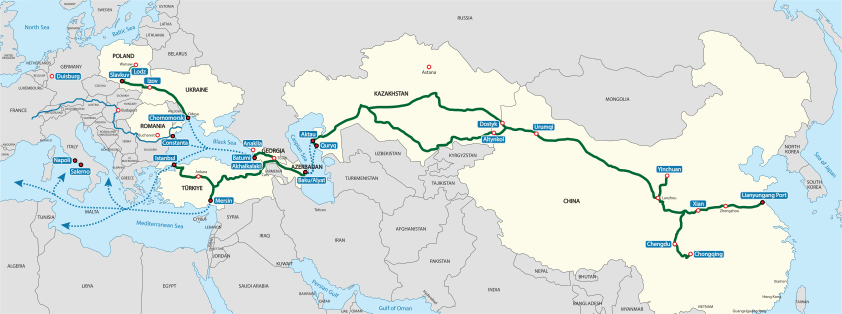
China → Kazakhstan → Caspian Sea ferry → Baku → Caucasus overland → Istanbul, Türkiye.

Geographical pivot: Türkiye sits at the western end of the corridor — via the Baku Tbilisi Kars (BTK) Railway through Azerbaijan and Georgia into Türkiye — and then onward into Europe shipments reach multiple European destinations, completely bypassing Russian rail or the Suez Canal. It’s faster than sea, cheaper than air, and safer than other land routes – perfect for businesses that can’t afford to gamble on delays.
Your All-in-One Logistics Partner
Secure Business Communications
Sensitive shipment details are often shared by email, such as quotations, shipping instructions, customs documents, and updates. ESCM uses secure business communication tools from Proton to encrypt and protect customer information.
Automatic Cash Payouts for Delayed Freight
Delays are the biggest freight risk. Protect your working capital with our Parametric Delay Insurance that automatically pays out if your shipment is delayed beyond a set point.
Avoid lengthy claims form or disputes

Guaranteed payouts within 14 days

Pick delay thresholds that suit your business

Works alongside your existing cargo insurance

Up to $250k protection per shipment

Reliable Freight. Real Results.
Disruptions and delays cost business.
Our team is based in a neutral country and we're a neutral operator. This helps us deliver reliable shipments.
And with our proprietary real-time IoT tracking, you see exactly where your shipment is at all times.
Trusted by Nordic Businesses
They do take care!
Business with ESCM have been always easy and smooth. Sensitive musicals instruments have been delivered and handled with care. Our cellos were damaged previously multiple times when carried by air freight.
Kimmo Virtanen
Would definitely recommend
Try it yourself.
Marie Schmitt
Been only reliable so far
Been only reliable so far.
Paul Richter
Future-Proof Freight Across Eurasia
We offer a stable alternative route that gets your shipments from Asia to Hamburg within 20 to 45 days. Weekly departures from Xi’an and Zhengzhou mean you get your goods when you need them. We were early movers into middle corridor logistics back in 2016, which means we’ve built good relationships with trusted partners and proven routes.
Smart Logistics for Growing Businesses
We specialise in freight across Finland, Sweden, Norway, Denmark, and Estonia, reliably moving machinery, equipment, components, and consumer goods. Our promise: on-time, right-first-time delivery. From smaller shipments to seasonal peaks and urgent orders, our experienced team keeps your business moving.

The route is ideal for large volumes of goods and containers, providing easier access to key markets in Europe, China, and Central Asia.

Fast
Faster than sea transit
Reliable
Less prone to disruption
Affordable
5 to 6x cheaper than air freight
Sustainable
10x less CO2 than air freight
Rail freight reduces CO₂ emissions by up to 80% compared to air freight
Combining rail and sea, ESCM helps Nordic SMEs build greener supply chains without sacrificing reliability.
Air = Fast, High CO₂
.
Rail = Balanced, Green
.
Sea = Low Cost, Slow
.
Rapid Customs Clearance
Our experience and established partnerships mean fast customs clearances
Eco-Friendly Operations
Reduce your carbon footprint with a transport mode that’s greener than air or road
Fair Pricing
No hidden charges with all handling fees included in the overall fixed rate
About Us
Silk Route Pioneers – 10+ Years of Experience
Since 2014, ESCM has led the way in rail freight between Asia and Europe, long before the current geopolitical crisis.
Our first shipment crossed the China-Kazakhstan border at the Dostyk and Khorgos stations, shortening the freight route between China and Europe, a faster alternative to the traditional Trans-Siberian Route that offers improved geopolitical security.
Since 2016, we've provided weekly, consistent services along this new route, boosting both the speed and reliability of shipments, even during the global pandemic.
We have local offices in Hong Kong and Finland to offer joined-up support between China and Europe. Therefore, we offer a personal, responsive logistics service, not a faceless global operation.
ESCM Train Freight Knowledge
Exploring the overland rail connection between China and Europe and how it can make your supply chain more resilient.
What is China to Europe train freight?
It is rail and multimodal freight services that move goods between China and Europe, often combining rail with sea, road, and final-mile delivery. It offers a practical middle ground that’s faster than sea and more cost-manageable than air.
What is the Middle Corridor route?
The Middle Corridor, also called the Trans-Caspian International Transport Route, links China and Europe via Kazakhstan, the Caspian Sea, Azerbaijan, Georgia and Türkiye, rather than using the northern route through Russia. For businesses transporting goods from China to Europe, it creates less dependence on a single politically-exposed corridor.
Why has the Middle Corridor become more important?
Since Russia’s full-scale invasion of Ukraine in February 2022 there has been a broader push for route diversification. Most overland China to Europe freight previously moved via Russia, but the middle corridor route improves trade connectivity reliability and supply-chain resilience.
How does the Middle Corridor actually work?
It consists of rail freight from China into Kazakhstan, sea crossing over the Caspian, rail through Azerbaijan and Georgia, then onward via rail into Türkiye, then Europe. At ESCM, we provide milestones and proactive updates, as it isn’t one simple uninterrupted rail line.
How long does China–Europe rail freight take?
The route is lane- and service-dependent, which means it varies between 20 to 45 days depending on route, handovers, border conditions, and final destination. Contact us for more details to assist with inventory, launch, and production planning.
How does train freight compare with sea freight and air freight?
Rail and multimodal are the middle option as they are faster than sea, and cheaper and lower-emission than air. China to Europe rail freight emerged as it offered a middle option for higher-value goods that did not suit either extreme. In other words, you get a better trade-off between speed, cost, and service continuity.
What kinds of cargo are best suited to the Middle Corridor?
Goods that are time-sensitive, value-dense, or important enough to need more speed than sea, but not so urgent that they justify air every time. Sectors such as electronics, fashion, machinery, equipment, components, and other higher-value imports benefit the most.
What are the main business benefits of using the Middle Corridor?
- More route diversification - Less exposure to Russia-linked disruption - Faster replenishment than sea on many lanes - Lower cost than air for many shipments - Better support for time-sensitive supply chains - Lower emissions than air freight
When was the regular rail connection between Europe and China established?
It began over one hundered years ago. The Trans-Siberian rail route from Europe to Harbin, China, was officially opened for regular through-traffic in 1903. 1896: Russia and China signed a treaty authorizing the construction of the Chinese Eastern Railway (CER), which acted as a shortcut across Manchuria (through Harbin) to Vladivostok. 1898: Construction of the CER began, with Harbin established as the administrative center and main construction hub. 1901: The "meeting of the rails" occurred as track-laying teams from the east and west met, effectively completing the physical line. 1903: The route was officially accepted into permanent operation. This allowed for the first regular rail communication between St. Petersburg/Moscow and the Pacific via Harbin.
The railways were similar to the internet and AI boom with the overland connection across the Eurasia continent being a major milestone in human history.
Unfortunately the first period of overland connection wasn't long lived. After the Russian Revolution & Civil War (1917–1924), the railway became a chaotic battleground between "Red" Bolsheviks, "White" Russian forces, and local Chinese authorities. This was followed by Sino - Soviet Conflit 1929 and The Japanese Occupation 1935 which was the final cut of this first regular traffic and connection between Europe and China.
Now, the middle rail corridor is seeing a ressurgence as an alternative to increasingly unstable supply chain routes.

When did the New Silk Route Freight Connection begin?
Before it had a fancy name or a geopolitical brand, the "New Silk Road" was just a train that went from Chongqing to Duisburg. The first Yuxinou (Chongqing-Xinjiang-Europe) freight train departed in January 2011, which changed everything.
It proved that moving high-value electronics (like laptops) from inland China to Germany by rail was faster than sea and cheaper than air. It was a "proof of concept" that convinced the world the route could be revived.
The "Belt and Road" strategy became global when President Xi Jinping officially proposed the initiative. On September 7, 2013 (in Astana, Kazakhstan), Xi proposed the "Silk Road Economic Belt", which is the land route crossing the Eurasia continent.

How has the New Silk Route developed since it's "official" opening in year 2013?
The connection didn't truly become a "network" until 2016, when all the different routes (Xi'an, Zhengzhou, Chengdu) were unified under the single "China-Europe Railway Express" (CR Express) brand.
In 2016, annual trips totalled around 1,700.
Last year, the network hit a massive milestone of 34,000 trips annually.
In just ten years, the New Silk Route has become the " Steel Artery" reality we see today.
2011–2013: Logistics experiment. Northern Route (via Russia/Kazakhstan) 2013–2022: Infrastructure build-out and expanded to 60+ Chinese cities 2023–2026: Resilience and diversification. Middle Corridor that bypasses Russia grows in popularity
How long has ESCM offered a regular service between China and Europe?
We have been a dedicated participant in the New Silk Road (China-Europe Railway Express) since 2016. We've witnessed the route’s modern development from a specialized logistics project into the world's most resilient trade corridor.
25+ Years’ Experience
.
Trusted By Many
.
Forward Thinking Employer
.
Cargo Delay Compensation Explained
Our Cargo Delay Compensation add-on helps protect your cash flow when cargo is delayed in transit.
It adds a financial safety net against qualifying delays, complementing your existing cargo insurance rather than replacing it.
How does ESCM Delay Compensation differ from my existing cargo cover?
Conventional cargo insurance usually covers physical loss or damage only. Our parametric insurance covers business interruption, consequential damages, additional costs, and price loss. In other words, it covers time and liquidity (the "clock"). While standard policies and carrier liability exclude financial losses caused by transit delays, we fill that gap. It creates no extra hassle for you, as we don’t replace your existing policy. If you choose to include delay compensation cover, we simply add it on as a financial safety net against supply chain disruption.
What exactly is Cargo Delay Compensation?
It is a data-driven guarantee that protects cash flow as well as cargo. Instead of a claims adjuster investigating "why" a delay happened, the policy relies on a mathematical trigger: Transit Time. When independent satellite data (AIS) or flight tracking (ADS-B) confirms your cargo has passed the 24-hour (Air) or 10-day (Sea) threshold, the delay compensation is triggered automatically.
Do I need to provide proof of financial loss to receive a Delay Compensation?
No. In a traditional claim, you must prove lost sales or factory downtime. With our parametric model, the payout is triggered by the event of the delay itself. The compensation funds are yours to use however you need to mitigate the disruption.
What are the specific delay triggers for Air and Sea freight?
We offer high-precision triggers tailored to the mode of transport: Air Cargo: 24-hour delay thresholds. Maritime Freight: 10-day delay thresholds. Note: Coverage begins the moment the cargo departs the port or airport of origin.
Does this cover "Acts of God" or labor strikes at ports or airports?
Yes. Unlike carrier liability, which often uses "Force Majeure" to avoid payment, our parametric insurance covers all-cause delays. Whether the delay is caused by severe weather, a natural catastrophe, or a strike at the port of transhipment, if the ship is late, you get paid. Note: Strikes are covered as long as the policy was bound before the strike became official.
Are there any major exclusions we should be aware of?
To maintain transparency, we exclude delays caused by: - Sanctioned parties (OFAC). - Illegal or hazardous cargo. - Missing/improper documentation provided by the shipper. - Bumped or Roll-over cargo at the initial point of departure.
- Major Cyber Attact or any Special Military Operation or act of terrorisim.

Does Cargo Delay Insurance protect againts Geopolitical Risks?
Traditional marine cargo insurance and even standard "War Risk" policies almost always exclude consequential loss or financial loss due to delay.
During geopolitical crises, carriers often invoke Force Majeure (Acts of God) to legally waive their liability for delays. For example, if a ship is diverted around the Cape of Good Hope to avoid a conflict zone, a traditional policy will not pay for the extra 15 days of transit time.
Parametric policy is different, as it is based on a mathematical trigger. Therefore, the carrier's "Force Majeure" defense does not apply and the "clock" is the only judge. If the shipment is late, the insurance pays without question.
Is it possible to have Delay Compensation for Rail Cargo?
At the moment Rail shipments between China and Europe are not covered by Delay Compensation.
Maritime Parametric Cargo Delay Insurance Case Study
01
1x40' POL Rauma, Finland – POD Norfolk, US
A real shipment. Six carrier ETA changes. One pre-agreed financial safety net.
Repeated schedule slippage can turn one shipment into a planning problem. Instead of waiting for disputes or claims handling, the delay trigger was set in advance and monitored automatically from departure to arrival.
Carrier schedule changes – total 6 ETA revisions before arrival on 5 March 2026
02
Parametric Delay in a Nutshell
Simple cover. Clear trigger. Fast outcome.
The policy is designed to protect against the financial impact of delay, not physical damage to cargo. Before departure, the customer selects the insured limit and the delay trigger. Once the vessel departs, the shipment timestamps are locked and monitored against the agreed arrival threshold.
03
In Reality
The shipment left on time, but the schedule did not hold
For this shipment from Rauma to Norfolk, the policy was activated on 28th January, 2026 at the vessel’s actual departure time. From that point, the original ETA and the agreed trigger formed the basis for the compensation calculation.
04
Policy Compensation
Delay crossed the trigger and compensation followed automatically
The shipment arrived 14 days after the original ETA recorded at departure. With a 10-day delay trigger and a USD 1,000 coverage limit, the policy paid out according to the agreed structure.
05
Cargo Delay Data Sources - Parametric Data Pipeline
Independent data. Locked timestamps. Trusted payout logic.
Parametric cover only works if the underlying shipment data is reliable. That's why the policy uses independent timestamping, cross-checked transport data, and audited payout logic to create a clear and trusted trigger process.
How data integrity is protected
Tailored Freight From Asia to the Nordics
Combining rail and sea, ESCM helps Nordic SMEs build greener supply chains without sacrificing reliability.